Top 10 Things to Do in the Atacama Desert, Ranked by Priority
The best things to do in the Atacama Desert are El Tatio Geysers at sunrise, Valle de la Luna at sunset, the full-day Piedras Rojas and Altiplanic Lagoons route, and a professional stargazing session, the four experiences that define what makes this desert unlike anywhere else on Earth. Everything below is reachable on a guided day trip from San Pedro de Atacama, the small oasis town at 2,407 meters that serves as the base for every excursion on this list. Rather than repeat the same recycled ranking of geysers, moon valley and salt flats you have probably already seen, this guide is built around one straightforward question: with a fixed number of days, what would you regret skipping, and what can wait? Every entry below links to the specific Atacama Desert tour that covers it, with current prices, timing and season notes rather than the outdated figures still floating around older travel guides.
Quick answer
The best things to do in the Atacama Desert are El Tatio Geysers at sunrise, Valle de la Luna at sunset, the Piedras Rojas and Altiplanic Lagoons full-day route, and a professional stargazing session, in that order of priority if your time is limited. Six more experiences, from the hidden lagoons of Baltinache to a Lickanantay culture tour, round out a longer stay and are ranked below with real prices and timing.
Key takeaways
- El Tatio Geysers, Valle de la Luna, Piedras Rojas and stargazing are the four experiences that define a short Atacama Desert trip.
- El Tatio and Valle de la Luna can be combined on the same day, geysers at dawn and Moon Valley at sunset.
- Stargazing quality depends more on moon phase than season, book within five to six days of a new moon.
- Baltinache and Laguna Cejar are the two best half-day floating experiences, Baltinache for solitude and Cejar for flexibility close to San Pedro.
- Four days covers the essential tier plus one or two highly recommended stops without rushing the 4:00 AM starts.
- Save El Tatio, Cerro Toco and the sunrise balloon for day three or later, after acclimatizing to San Pedro's 2,407 meters.
The 4 Essential Atacama Desert Experiences
1. El Tatio Geysers at Sunrise
El Tatio ranks first because nothing else in the region combines altitude, timing and scale the same way. At 4,320 meters it is the highest geyser field on Earth and the largest in the Southern Hemisphere, with more than 80 vents that erupt hardest in the 90 minutes after sunrise, when subzero air meets superheated steam and throws columns up to six meters high. Wait until after 8:30 or 9:00 in the morning and the show is mostly over as the desert warms. Tours leave San Pedro around 4:00 AM for the roughly two-hour drive, and the El Tatio geysers sunrise tour folds in a stop at the Putana wetlands for flamingos and vicuñas plus a hot breakfast served with the geysers still hissing nearby.
Save this one for day three or later. At 4,320 meters, altitude symptoms hit hard on travelers who have not yet spent time acclimatizing in San Pedro's 2,407 meters.
A verified tour reviewer, rating the tour five stars, put it simply: "Standing there as the sun came up over the steam columns, I actually got emotional. I didn't expect that. It looked like the beginning of the world."
2. Valle de la Luna (Moon Valley) at Sunset
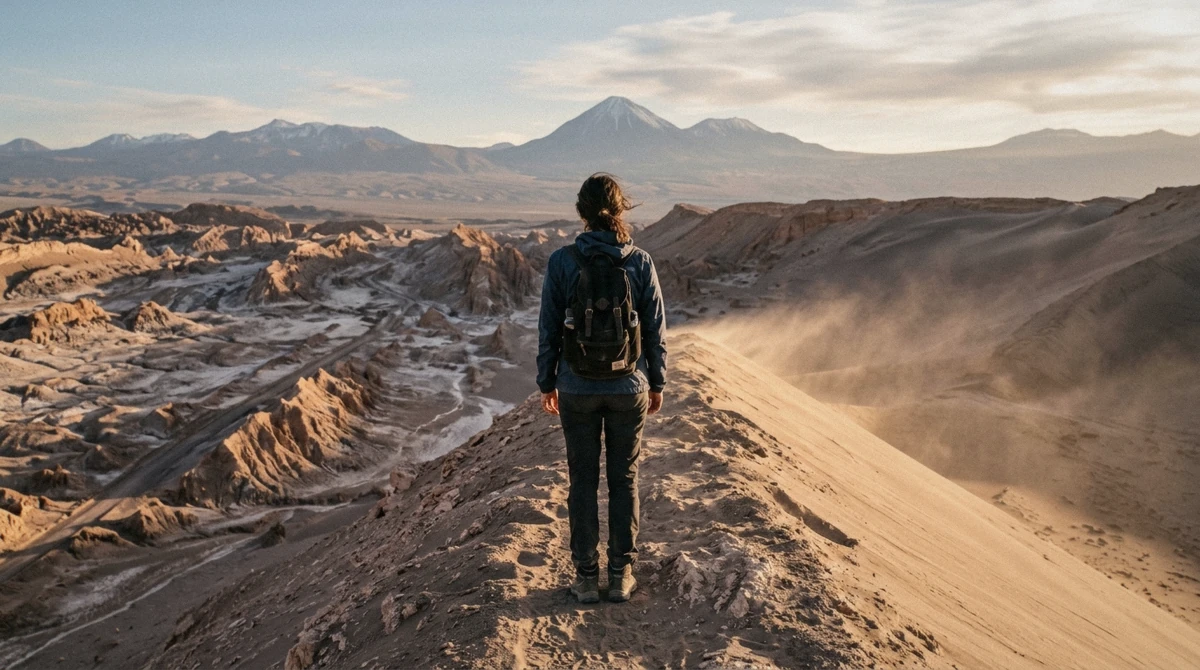
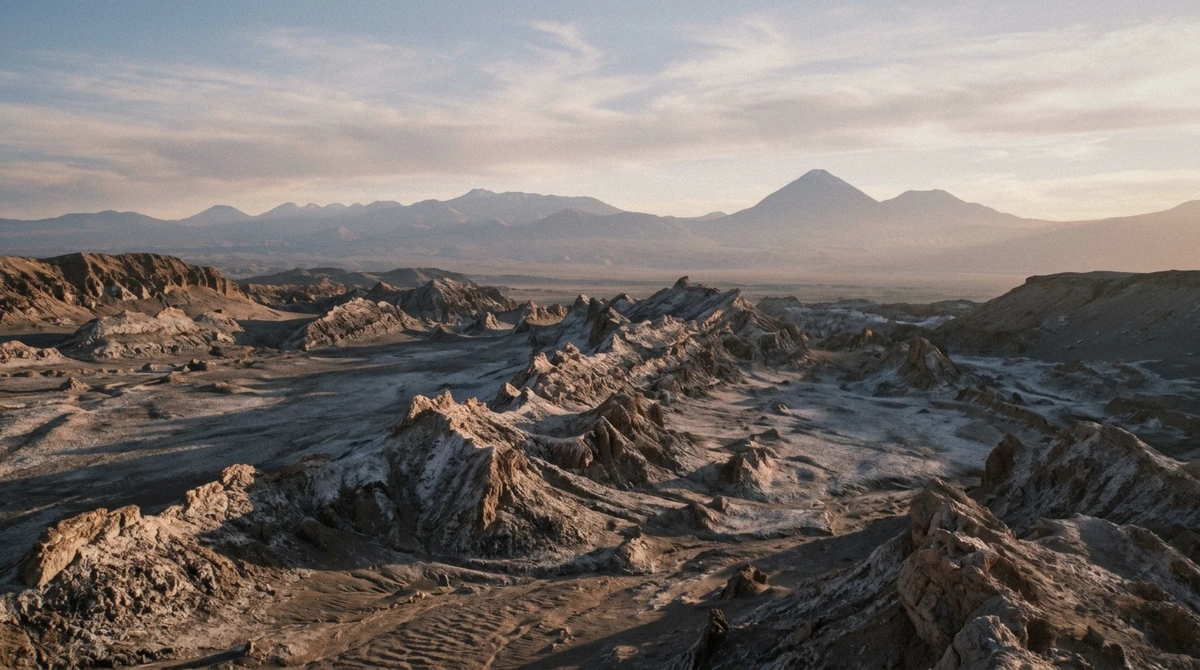
Valle de la Luna earns the second spot because it is one of the only landscapes in the Atacama that looks better in person than in photos. Ten kilometers from San Pedro, salt-crusted canyons, the wind-carved Tres Marías formations and the Gran Duna sit inside a basin so dry that NASA has used it to test Mars rover instruments. Go for sunset, not sunrise: tours typically pick up between 3:00 and 4:00 PM and time the final viewpoint stop, usually Mirador de Ckari, for the moment the valley shifts from white to gold to deep amber. The Valle de la Luna sunset tour usually finishes with a pisco sour at the lookout.
A same-day pairing with El Tatio works well for travelers on a tight schedule: the geyser tour is back in San Pedro by late morning, leaving the afternoon free for Moon Valley.
3. Piedras Rojas and the Altiplanic Lagoons (Full Day)
Ask any San Pedro guide which single tour travelers come back talking about most, and Piedras Rojas wins more often than any other option on this list. The route climbs to the Miscanti and Miñiques lagoons at roughly 4,120 meters, electric-blue water reflecting snow-capped volcanoes, then continues to Piedras Rojas itself, where rust-red rock sits in a turquoise saline lake against white salt flat, before finishing at Laguna Chaxa in the Salar de Atacama for flamingo watching at golden hour. It cannot be compressed into a half day: tours run around 10 hours, departing San Pedro near 6:00 to 6:30 AM with breakfast served at altitude.
- Miscanti and Miñiques lagoons at roughly 4,120 meters
- Piedras Rojas: rust-red rock against a turquoise saline lake
- Laguna Chaxa: three flamingo species inside the Salar de Atacama
Book this for day three or later, once you have acclimatized past El Tatio's altitude. The Piedras Rojas and Altiplanic Lagoons full-day tour currently runs from $85 and includes both meals.
Another five-star verified tour reviewer summed it up: "This is my favourite tour out of all the tours I've taken around the world. Our guide Francisca was incredible. The Piedras Rojas are really the highlight of a trip to Atacama."
4. Stargazing at a Professional-Grade Observatory
The Atacama holds more than two-thirds of the world's most advanced astronomical observatories, and the reason is straightforward: more than 300 clear nights a year, some of the lowest light pollution on the planet, and desert air too dry to hold the humidity that would otherwise blur the view. A 2.5-hour guided session with research-grade telescopes lets you see Saturn's rings and the Milky Way's core with your own eyes rather than through someone else's photo. Sessions typically run from around 9:00 to 11:30 PM, arriving at dusk for naked-eye constellation orientation before full dark sets in.
The single detail that matters more than any other is moon phase. A full moon can wash out roughly 80 percent of what you would otherwise see, so book within five or six days of a new moon whenever your dates allow it. The Atacama Desert stargazing tour runs small groups with an astronomer guide, telescopes, hot drinks and a campfire, from $33 for 2.5 hours.
A five-star verified tour reviewer wrote: "I've done stargazing in New Zealand, Iceland, and the Sahara. Nothing comes close. The guide showed us Jupiter's moons through the telescope and I genuinely couldn't speak for a moment."
Together these four cover what separates the Atacama from every other desert on Earth:
- A geyser field that erupts hardest in the 90 minutes after sunrise
- A landscape NASA has used to calibrate Mars instruments
- A single-day route linking two lagoon systems and a flamingo reserve
- A night sky considered among the clearest anywhere on the planet
5 to 7: Highly Recommended Atacama Desert Tours to Add
5. The Hidden Lagoons of Baltinache
Baltinache rewards travelers who have an extra half day more than almost anything else on this list. Seven turquoise salt pools sit tucked into the Cordillera de Sal, far enough off the standard circuit that arriving before 9:00 AM often means having them to yourself before the group tours show up. The water carries enough salinity that floating takes no real effort, the same principle behind the Dead Sea.
One of the seven lagoons reopened for swimming after a conservation closure, so the experience is better now than it has been in several years. The Baltinache lagoons magic bus tour runs about four hours and currently starts from $71, with the afternoon free afterward for stargazing the same evening. The WaylessTravelers travel blog called it "the most Instagrammable experience in the Atacama and one of the most unique things we did in all of South America," adding that "swimming in those turquoise salt pools surrounded by mountains and desert is a really cool experience."
6. Float in Laguna Cejar
Laguna Cejar is a sinkhole lake inside the Salar de Atacama with salt concentration reaching 28 percent, high enough that floating takes zero effort, arms out, looking up at a ring of Andean volcanoes. It sits closer to San Pedro than Baltinache does, which makes it the more flexible half-day choice when your schedule is tight. Most tours pair a morning float at Cejar, when the water is calmer and cooler, with the Ojos del Salar sinkholes and a sunset pisco sour at Laguna Tebenquiche, where the salt flat turns pink and gold as the light drops. Cejar tours currently start from $38 for around four hours and are featured among the landscape tours on the homepage.
The Kipling & Clark travel blog described it this way: "Floating peacefully in the water and then sitting on the edge of the lake staring at the majestic Andes rising above it was well worth it. Only one other person was in sight when I went in the morning."
7. Sunrise Hot Air Balloon Ride
A hot air balloon at dawn turns the Atacama into something closer to a topographic map than a desert you are standing in. Liftoff happens before sunrise, and as the balloon climbs, Licancabur volcano appears on the horizon while the first light spreads across salt flats and dune fields below. The full outing runs about three and a half hours including breakfast before liftoff, and pricing reflects the scale of the operation: the sunrise hot air balloon ride starts from $350, well above anything else on this list, which is why it sits in this tier rather than the essential one despite being one of the most talked-about mornings in San Pedro.
A guest named Christopher wrote: "One of the best experiences ever, from the morning breakfast to learning the history of the balloon itself. Watching the sunrise over the desert was incredible, and the post-landing champagne and cheese was the perfect ending."
Quick Comparison: All 10 Experiences at a Glance
Here is how all ten experiences compare on time, cost and timing, using current tour prices rather than the figures still quoted on older guides.
| Experience | Priority Tier | Time Needed | Cost From | Best Time of Day |
|---|---|---|---|---|
| El Tatio Geysers | Essential | 7 hours | $81 | Dawn (4:00 AM start) |
| Valle de la Luna Sunset | Essential | 4.5 hours | $59 | Mid-afternoon to sunset |
| Piedras Rojas + Lagoons | Essential | 10 hours | $85 | Full day |
| Stargazing | Essential | 2.5 hours | $33 | Night, near a new moon |
| Baltinache Lagoons | Highly recommended | 4 hours | $71 | Early morning |
| Laguna Cejar Float | Highly recommended | 4 hours | $38 | Morning float, sunset nearby |
| Sunrise Balloon Ride | Highly recommended | 3.5 hours | $350 | Dawn |
| Cerro Toco Summit | If you have time | 7 hours | $120 | Early morning |
| Desert Buggy Tour | If you have time | 3 hours | $145 | Afternoon |
| Lickanantay Culture Tour | If you have time | 3 hours | $73 | Morning |
The tiers above are a starting point, not a rule. If flamingos matter more to you than salt pools, build extra time into the Chaxa stop on your Piedras Rojas day and move Baltinache down the list; if the balloon fits your budget, it can just as easily replace a rest morning as follow one.
8 to 10: Three More Atacama Desert Experiences If You Have Time
8. Climb Cerro Toco's Summit
Cerro Toco tops out at 5,604 meters, higher than Everest Base Camp at 5,364 meters, but the climb itself is manageable for anyone reasonably fit who has spent at least two days acclimatizing in San Pedro first. Guides set a slow, steady pace up loose volcanic scree, and the payoff at the top is a 360-degree view across the Salar de Atacama, the ALMA observatory's antenna array on the Chajnantor plateau, and a chain of volcanoes running along the Bolivian border. The Cerro Toco summit hike runs about seven hours and starts from $120.
Attempt this only after El Tatio and Piedras Rojas, once your body has had a few days at altitude behind it.
9. Buggy Through the Cordillera de la Sal
For travelers who want to drive rather than ride, the desert buggy tour is the one common Atacama excursion where you take the wheel yourself. Each traveler pilots an open-air 4x4 buggy through riverbed crossings, mountain climbs and sand dunes in a guide-led convoy, reaching terrain minivans cannot access. The guided desert buggy tour runs about three hours from $145.
Prefer two wheels to four: the Moon Valley e-bike tour covers 32 kilometers of the same Salt Mountain Range on an electric bike instead.
10. Lickanantay Ancestral Culture Tour
Every tour on this list moves through land the Lickanantay people have managed for centuries, and this is the one that puts that history at the center instead of the scenery. Walking alongside llamas through Turi and Kunza territory, a Lickanantay family shares ancestral herding practices, pottery traditions and how they read the desert for water and grazing, rather than a guide reciting facts from a script. The Lickanantay ancestral tour with llamas runs about three hours and starts from $73, and pairs naturally with a quieter half day after the higher-altitude tours earlier in a trip.
Sequencing Your Days, Whether You Have Three or Ten
Altitude decides the order, not preference. San Pedro sits at 2,407 meters, but El Tatio reaches 4,320 and Cerro Toco climbs to 5,604, so the first day or two should stay low while your body adjusts. Three days can cover the four essential experiences if planned tightly: El Tatio and Moon Valley on day one, Piedras Rojas on day two, stargazing that same evening or the next.
Four days is the more comfortable version of the same plan, with one recovery morning built in after the 4:00 AM geyser start. For a longer breakdown of pacing across a full trip, see how many days you actually need in the Atacama Desert and what each month brings for weather, crowds and flamingo numbers. For a full cost breakdown across every tour on this list, see what a trip to the Atacama Desert actually costs.
- Day 1: low altitude only, Moon Valley or a rest day at San Pedro's 2,407 meters
- Day 2: Piedras Rojas or Baltinache, once mild acclimatization has kicked in
- Day 3+: El Tatio, Cerro Toco or the sunrise balloon, the highest and most demanding options
- Any clear evening close to a new moon: stargazing
Frequently Asked Questions
What are the best things to do in the Atacama Desert for a first visit?
El Tatio Geysers at sunrise and Valle de la Luna at sunset on the same day, followed by Piedras Rojas the next day and a stargazing tour that evening. Those four experiences cover what makes the Atacama different from anywhere else on Earth. Add Baltinache or Laguna Cejar if a fifth half day is available, both pair naturally with a stargazing evening.
Can I do El Tatio Geysers and Valle de la Luna on the same day?
Yes, and many travelers do exactly this. The El Tatio tour returns to San Pedro by around 11:00 or 11:30 AM, leaving time to eat and rest before an afternoon Valle de la Luna pickup between 3:00 and 4:00 PM. It is a long day, roughly 4:00 AM to sunset, but it frees up a full extra day for Piedras Rojas.
How many days do I need to see the top 10 things to do in the Atacama Desert?
Three days covers the four essential experiences if planned tightly, four days adds one or two highly recommended stops without rushing the early starts, and five to seven days works through the full list including Cerro Toco and the culture tour. See how many days you actually need in the Atacama Desert for a day-by-day plan.
What is the best time of year to visit the Atacama Desert?
It depends on which experience matters most: June through August gives the sharpest stargazing skies, December through February brings the largest flamingo flocks to Chaxa and Cejar, and the shoulder months of September to November and March to May balance mild weather with lighter crowds. See the full month-by-month breakdown for specifics.
Is Laguna Cejar or Baltinache better for floating?
Baltinache is better for solitude, since its distance from San Pedro keeps group sizes smaller, especially before 9:00 AM. Laguna Cejar is better for flexibility, since it sits closer to town and pairs easily with a sunset stop at Tebenquiche the same afternoon. Both reach salinity high enough that floating takes no real effort.
Do I need to book Atacama Desert tours in advance?
Yes, especially during December through February and around Chilean holidays. Stargazing sessions and the Piedras Rojas full-day route fill up days ahead in high season, and national park entrance tickets for Valle de la Luna, Piedras Rojas and the altiplanic lagoons must be purchased online before arrival, not at the gate.